

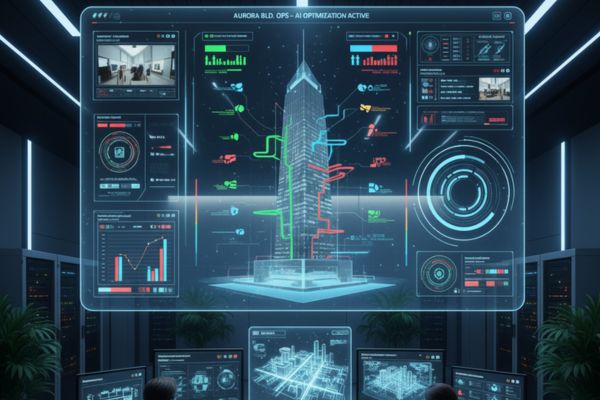
In the context of smart buildings and the future of building operations, the application of AI in building management is an extremely contentious subject. However, AI holds great potential for the entire building lifecycle.
From system design and construction to installation, operation, maintenance, deconstruction, and disposal, artificial intelligence (AI) has the potential to provide comprehensive support for daily tasks.
Visualize a building that creates flexible, comfortable spaces for its residents on its own, detects problems before anybody notices them, and controls energy as though it knew the future weather.
AI in building management has brought about this new reality. This is not a work of scientific fiction. As buildings become larger, more complex, and sustainability goals become increasingly urgent, artificial intelligence is emerging as the final element that completes the picture.
Understanding Building Management
A Building Management System (BMS) is a computerized, centrally operated system that monitors, controls, and optimizes a building’s mechanical and electrical equipment, including HVAC, lighting, security, and fire systems, from a single interface, thereby improving energy efficiency, comfort, safety, and operating costs.
It guarantees optimal performance, reduces waste, and provides facility managers with remote management and insights by utilizing data and sensors to make real-time adjustments. Building management system is critical to every building as it can help facility managers get relevant insight about their building.
Elements of AI in Building Management Systems
The element of AI in building management systems is critical, as it paves the way to understanding how AI transforms building management systems. Together, these elements allow for smart building operations.
Machine Learning Processes
Machine learning techniques are the cornerstone of AI in building management. These algorithms, which include deep learning, predictive modeling, and reinforcement learning, examine both past and present data to identify patterns, anticipate future trends, and enhance building operations.
Data Sensors
The foundation of an AI-driven BMS is the extensive network of sensors positioned throughout a building. These sensors collect a lot of information on temperature, humidity, light, occupancy, equipment performance, and energy consumption. The volume and granularity of this data are crucial for AI systems to learn and derive useful insights.

Actuators Systems
These convert AI insights into useful control commands. These solutions provide a closed-loop optimization process by using AI-driven recommendations to modify HVAC settings, equipment operations, security procedures, and lighting levels.
Benefits of AI In Building Management
In the age of smart technology, artificial intelligence (AI) is revolutionizing building operations and administration. Buildings, from skyscrapers to university campuses, are becoming more responsive, sustainable, and efficient thanks to AI-assisted building management systems.
The phrase “AI-assisted building management system” refers to the application of AI technology in traditional building management systems to enhance the monitoring, control, and optimization of building operations. The following are more advantages of AI in building management systems by 2025.
- Energy Performance: Artificial intelligence (AI) algorithms estimate energy demand and optimize use using data from smart sensors, resulting in significant cost savings and reduced carbon emissions.
- Increased efficiency: Smart systems may adjust temperature and lighting based on occupancy patterns to maximize comfort and increase output.
- Forecasting Repair: By continuously monitoring building operating systems, AI may predict equipment issues before they arise, lowering maintenance costs and downtime.
- Enhanced security: AI-driven monitoring systems are more adept at spotting unusual activity and responding to threats. Interestingly, it can spot any security issues and provide alert for you to handle.
Drawbacks of Artificial Intelligence in Building Management Systems
AI provides many benefits for building management, but there are certain things to think about. The quality of the data used by AI systems is crucial. Your building data must be accurate and of the highest caliber for AI in building management systems to function properly. After all, the data an algorithm utilizes determines how accurate and reliable it can be.
Let us also talk about the cost of incorporating smart reasoning into structures. Depending on how complex your building management system is, you may need to upgrade your hardware or boost your processing power for such AI-driven solutions to work correctly. Keep in mind that you must expand the capabilities of your operational crew to handle all the new technologies.
AI In Building Management: The Rising Transformation in Building Management
Today, building managers are learning that AI-driven building management goes well beyond simple automation. These systems are capable of learning, adapting, and making judgments that, only a few years ago, would have required hours of human supervision.
Energy Optimization and Sustainability
Everywhere, energy bills are taking a lack chunk of facility budgets, but AI in building management is completely altering that. In AI-driven buildings, AI-powered systems track trends in energy use and automatically modify lighting, heating, and cooling based on occupancy, weather, and utility costs.
Without compromising comfort, AI-powered smart HVAC systems can cut energy usage by 20–30%. These systems efficiently pre-heat or pre-cool areas by learning from weather forecasts and building usage patterns. This is aptly shown by Microsoft’s campus renovation, where its AI-powered technologies contributed to a 30% decrease in energy consumption while raising tenant happiness.
Predictive Maintenance and Asset Management
Do you recall the days when unexpected downtime and a frantic search for repair teams were the results of equipment failures? Those times are rapidly fading. By examining trends in temperature measurements, vibration data, and usage patterns, AI in building energy management now predicts equipment problems before they occur.
Consider maintenance for elevators. Smart building management systems can continually monitor elevator operation and identify any problems weeks before they become problems, as opposed to adhering to strict inspection schedules. By addressing minor problems before they become major difficulties, this method decreases downtime by up to 70% and drastically lowers repair costs. In a hospital building management system, predictive maintenance is even more critical, as it ensures continuous operation of life-support equipment, climate-sensitive medical areas, and essential infrastructure without risking patient safety.
Cost Efficiency and Operational Insights
AI’s true potential is found in its capacity to transform data into insights that can be put into practice. AI-powered dashboards that offer precise suggestions for resource distribution, maintenance scheduling, and operational enhancements are now available to building managers.
To make suggestions that people would overlook, these systems examine thousands of data points, ranging from maintenance records and energy consumption to occupancy trends and weather forecasts. The result is an improved decision-making based on thorough data analysis as opposed to intuition or incomplete knowledge.
Security and Risk Management
Conventional key cards and surveillance cameras are no longer the exclusive forms of building protection. These days, AI in building management incorporates advanced video analytics that can identify anomalous behavior patterns, illegal entry attempts, and even possible safety risks.
Contemporary artificial intelligence security systems can recognize when an individual enters a restricted area, determine whether safety gear is being worn in industrial settings, and even forecast possible security threats based on trends in past data. Businesses that use AI security solutions claim much fewer false alarms and 40% quicker incident reaction times.
Conclusion
The real potential of AI in building management systems is found not only in improving operational metrics but also in cultivating a symbiotic relationship between people and their environment, resulting in environments that are not only smart and efficient but also highly sensitive to life’s rhythms and the necessity of ecological harmony.
As we entrust more complex cognitive systems to control the environments in which people live, work, and flourish, this calls for a constant reassessment of our ethical frameworks and social priorities.